
The world's largest insurers are sounding a clear warning: climate risk is outpacing traditional insurance models. The question for insurers is no longer just how to price that risk — it's how to help customers reduce it before entire categories of coverage disappear.
Günther Thallinger, a member of the management board at Allianz SE — Europe's largest primary insurer — made headlines recently when he acknowledged that certain locations and perils can no longer be covered in the way insurers would wish. Heat, floods, storms and wildfires, he said, "could become so frequent that they challenge traditional insurance models" and that risk-adequate pricing would simply not be affordable for many property owners.
It is a striking admission from one of the industry's most senior voices. But it reflects a reality that loss control teams, underwriters and brokers across the property and casualty market have been confronting for several years: in the most exposed regions, the gap between what climate risk requires in premium terms and what policyholders can or will pay is widening fast.

That shift from risk transfer to risk reduction is a significant one. And it raises a practical question: how do insurers actually deliver it at scale?
The Adaptation Gap
The challenge is not that homeowners and commercial property owners are unwilling to invest in resilience upgrades. Research consistently shows that when people understand the financial case — the net cost after grants and rebates, the insurance savings, the reduced exposure to disruption — a meaningful proportion will act.
The problem is that the information required to make that case is fragmented, fast-moving and rarely presented in a form that a policyholder can act on. Federal, state, municipal and utility incentive programs for resilience upgrades number in the hundreds. They vary by state, by property type, by income level, by the specific upgrade being considered. They change constantly. And they are almost never surfaced at the moment when a policyholder is most motivated — which is precisely when they have just received a renewal notice with a significant premium increase, or when they have been told their property no longer qualifies for standard coverage.
Insurers have the relationship, the moment of engagement and the motivation to bridge that gap. What most have lacked is the tooling to do it efficiently and at scale.
What Adaptation Intelligence Looks Like in Practice
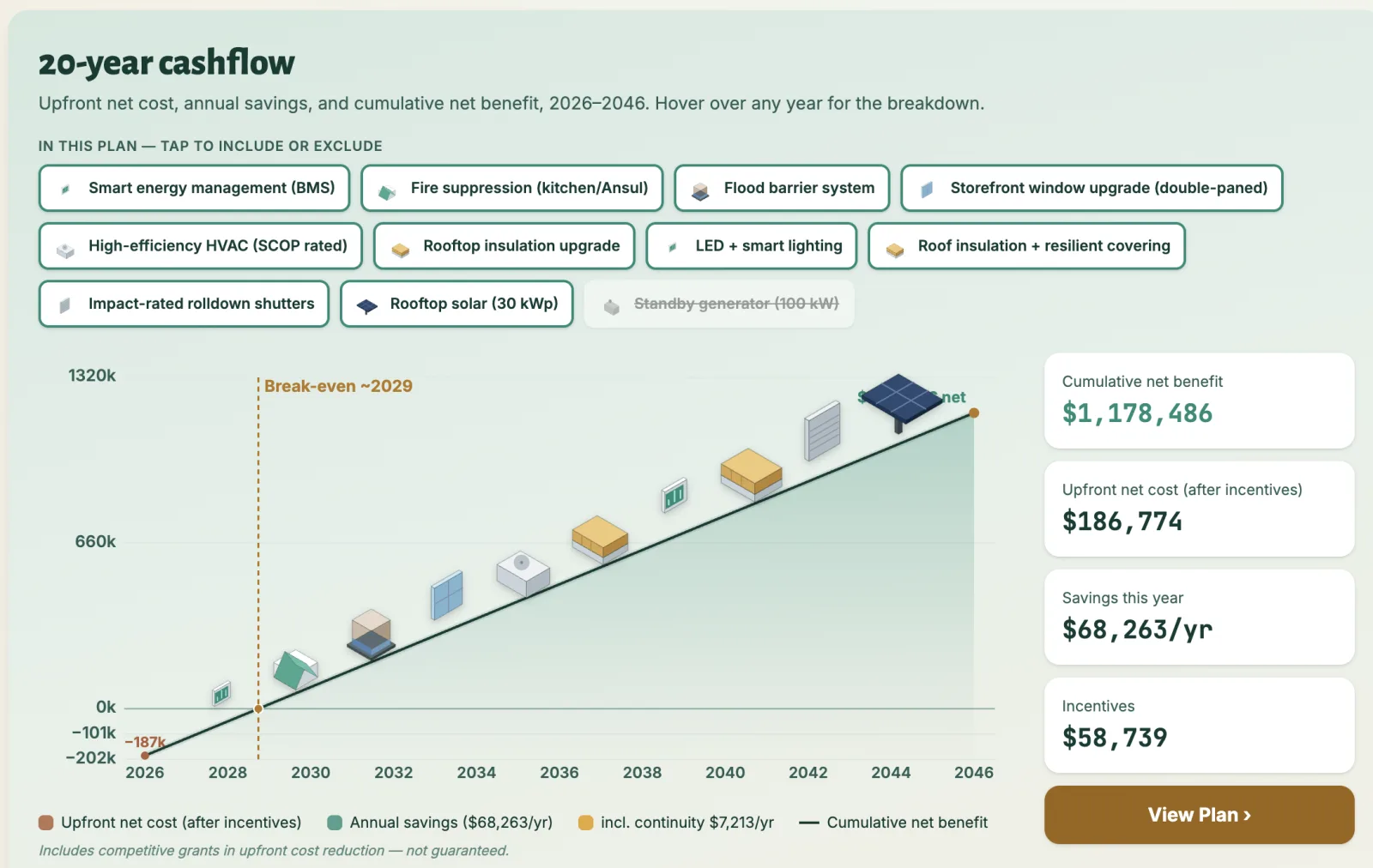
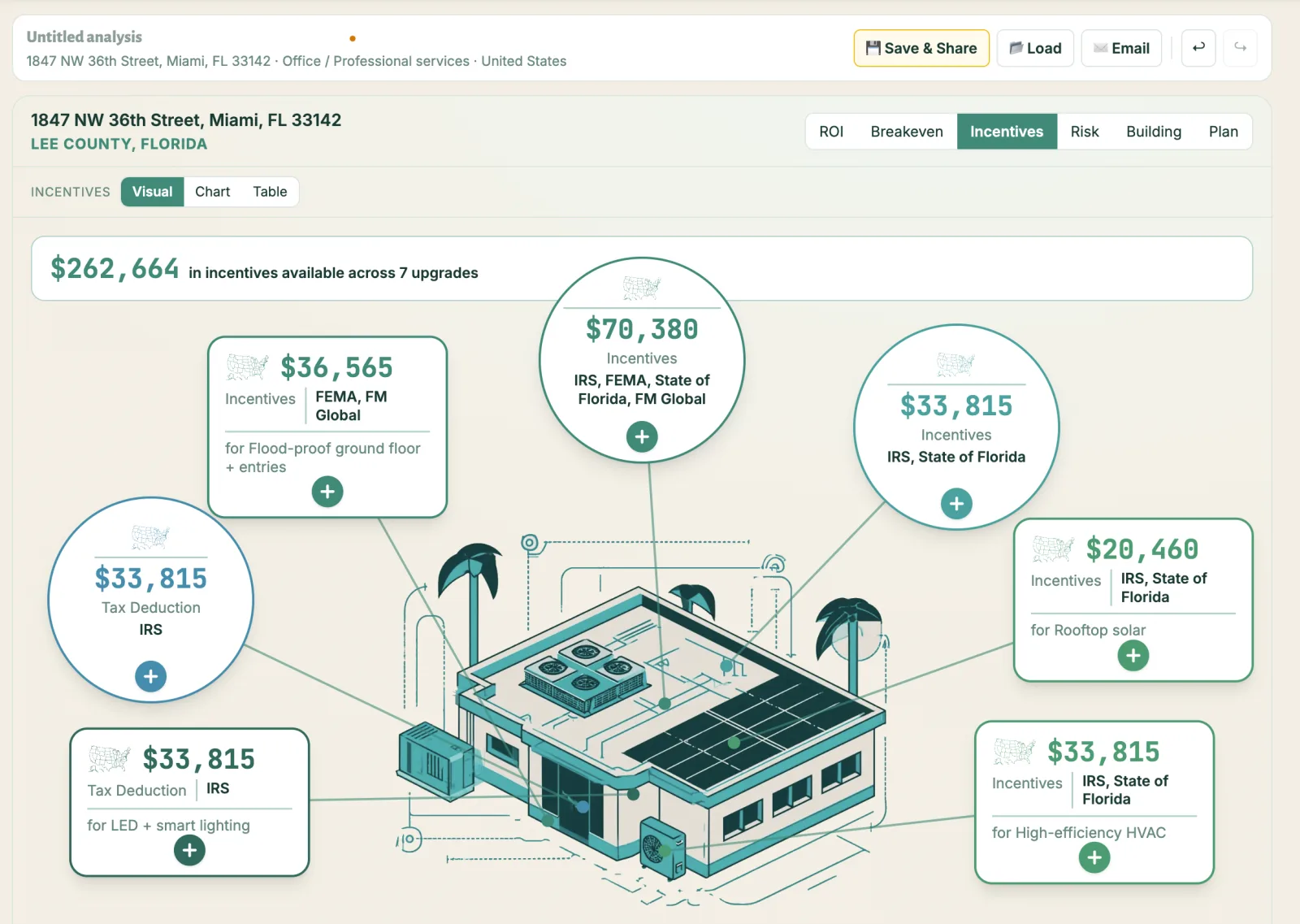
For insurers, that data becomes the foundation for white-label tools that can be embedded directly into policyholder-facing communications, renewal workflows or loss control portals.
A policyholder enters their address and property type. They immediately see every incentive they qualify for, an estimate of what each upgrade costs after grants and rebates, and a cashflow chart showing how long each investment takes to pay for itself through premium savings, energy savings and avoided claims costs. The whole interaction takes minutes. No phone calls, no spreadsheets, no referral to a third-party website.
The result is a materially different kind of renewal conversation — one where the insurer arrives not just with a higher premium, but with a concrete plan for what the policyholder can do to bring that premium back down, or to remain insurable at all.
The Business Case for Insurers
There is also a customer retention dimension that should not be underestimated. When a policyholder faces a significant premium increase or a non-renewal notice, the instinct is to blame the insurer. Insurers who can respond with actionable guidance — here is what you can do, here is what it will cost, here is what it will save you — are more likely to retain that relationship through a difficult moment.
Allianz's Thallinger framed it clearly: failing to help customers adapt does not make the risk go away. It simply means the customer eventually loses access to coverage entirely, and the insurer loses a customer they might otherwise have retained.
A Scalable Infrastructure for Adaptation
AtlasAdapt is designed to be embedded, not to replace existing insurer infrastructure. Our tools sit inside your brand, inside your workflows, and draw on data that is maintained specifically for this purpose — not licensed once and left to go stale.
For loss control teams, our data APIs integrate directly into existing platforms. For customer-facing teams, our white-label widgets and microsites can be deployed on policyholder portals or embedded in renewal communications with minimal technical overhead. For brokers and MGAs distributing personal and commercial lines, our tools can be deployed as a value-added service that differentiates their offering and creates a reason for clients to engage before renewal.
The underlying insight is the same one that Allianz's board member articulated: when traditional insurance models are under pressure from climate risk, the answer is not simply to price that risk into premiums until coverage becomes unaffordable. The answer is to help customers reduce the risk — and to give them the tools and information to do it in a way that makes financial sense for them.
That is what AtlasAdapt is built to do.
AtlasAdapt delivers property resilience intelligence for insurers, brokers, lenders and property owners — white-label widgets, microsites and data APIs that surface incentives, model upgrade economics and drive adaptation decisions. To see what our tools look like inside your brand and your workflows, request a demo.
Sources
Climate Change Keeps Adding to List of Uninsurable Assets, Allianz Executive Says — Insurance Journal, July 1st 2026.