
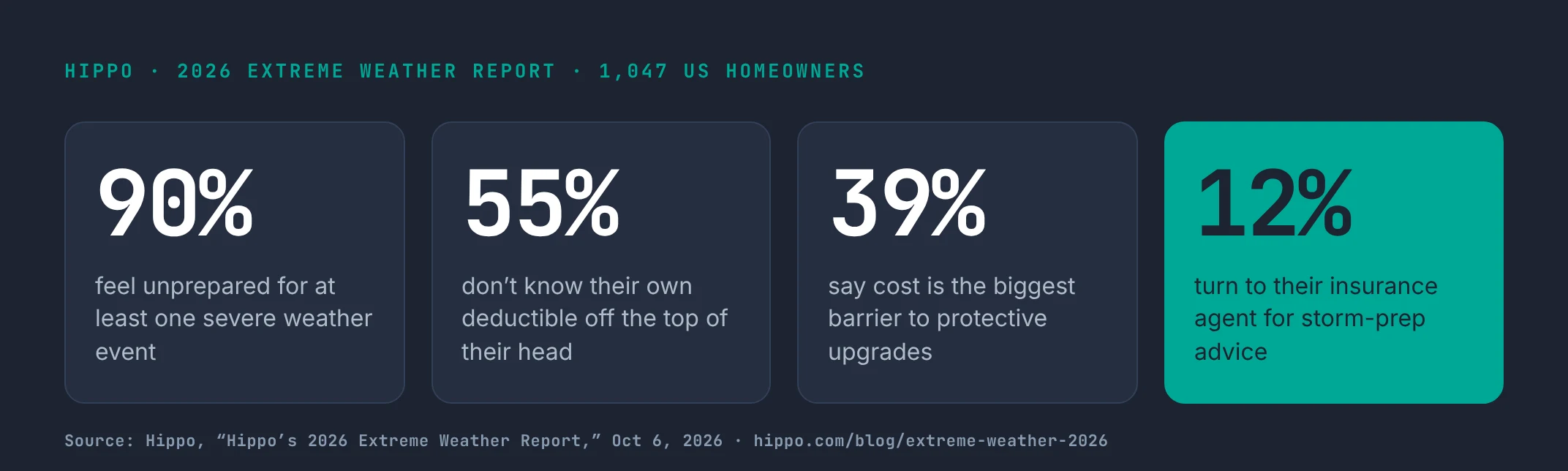
Hippo’s third annual Extreme Weather Report, published October 6, finds that 90% of US homeowners feel unprepared for at least one severe weather event, even though 85% actively monitor weather alerts where they live.
The survey of 1,047 homeowners, conducted by Centiment for Hippo in July 2026, is worth reading in full. Its central finding is simple: knowing a storm is coming and being ready for it, physically or financially, are two different things. For anyone who insures, advises on or lends against residential property, the more useful finding is where homeowners go for help closing that gap, and where they don’t.
Concern is high. Preparation isn’t.
Nearly 60% of homeowners have had storm-related damage to their home in the past three years, and 68% are concerned extreme weather will damage it. Yet only 18% feel very prepared to protect it. Just 21% have reviewed their policy to understand what’s covered, and 31% took no preparedness action at all in the past 12 months.
58% of homeowners say high winds are the weather event they feel least ready for, the highest of any risk Hippo measured, ahead of heavy rain or flooding (41%), winter weather (31%) and extreme heat (28%).
Hippo offers a plausible reason: individual high-wind events are harder to forecast than a hurricane season or a cold snap, so preparation never becomes part of a routine. That matters, because wind is also where hardening is most established. The IBHS FORTIFIED standard, state retrofit grants and wind-mitigation insurance discounts in several coastal states all exist for exactly this peril. Homeowners just aren’t connecting their worry to them.
The policy is a black box
The coverage findings are the ones that should concern anyone in insurance distribution. 37% of homeowners couldn’t confidently explain what their policy covers for weather damage without looking it up. 55% don’t know their own deductible off the top of their head. And 39% have assumed something was covered, only to find out it wasn’t.
19% of all homeowners surveyed say a wrong assumption about their coverage cost them money out of pocket.
This is less a failing of homeowners than of how the information reaches them: a policy document once a year, a deductible chosen at binding, and no picture of what any of it means for the specific risks at their own address.
The bill lands at home, and it stays there
Half of US homeowners have paid out of pocket for weather-related damage in the past three years. Among them, 22% are still carrying debt from it, and 71% of those have carried it for two years or more. Among homeowners who experienced damage, 18% delayed a major home improvement because of it and 16% delayed contributing to savings or retirement.
Only 22% say they are truly financially prepared for an unexpected weather-related repair. Another 44% could manage, but it would be a stretch. The remaining 34% say it would cause real financial stress, or that they simply couldn’t cover it.
39% say cost is the biggest barrier to making protective upgrades, ahead of doubting that upgrades would make a difference (21%) or not knowing which ones are needed (18%).
That ranking is the most actionable line in the report. The main objection isn’t apathy or ignorance. It’s price. And price is the one objection that can be answered with numbers specific to a single property.
The trust gap is the opening
Asked where they turn for storm-prep advice, homeowners named a local meteorologist (65%) and friends and family (31%) well ahead of their own insurance agent (12%).
Only 12% of homeowners turn to their insurance agent for storm-prep advice. 65% turn to a local meteorologist.
The meteorologist can tell you a storm is coming. The agent, broker or lender is the one who knows what the policy will and won’t pay, which upgrades reduce the risk, and which grants and insurance credits can help pay for them. They are the best-placed people to answer the 39% who say cost is in the way. They just aren’t the ones being asked.
Hippo frames this as a gap it wants to close, by helping homeowners prevent damage rather than only stepping in after it happens. That shift from paying claims to preventing them is the right direction for the whole distribution chain, not just carriers.
What answering “is it worth it?” looks like
An advisory conversation about resilience needs three things most homeowners don’t have: the hazards at their specific address, the upgrades that reduce them with realistic costs, and the money that already exists to pay for part of the work.
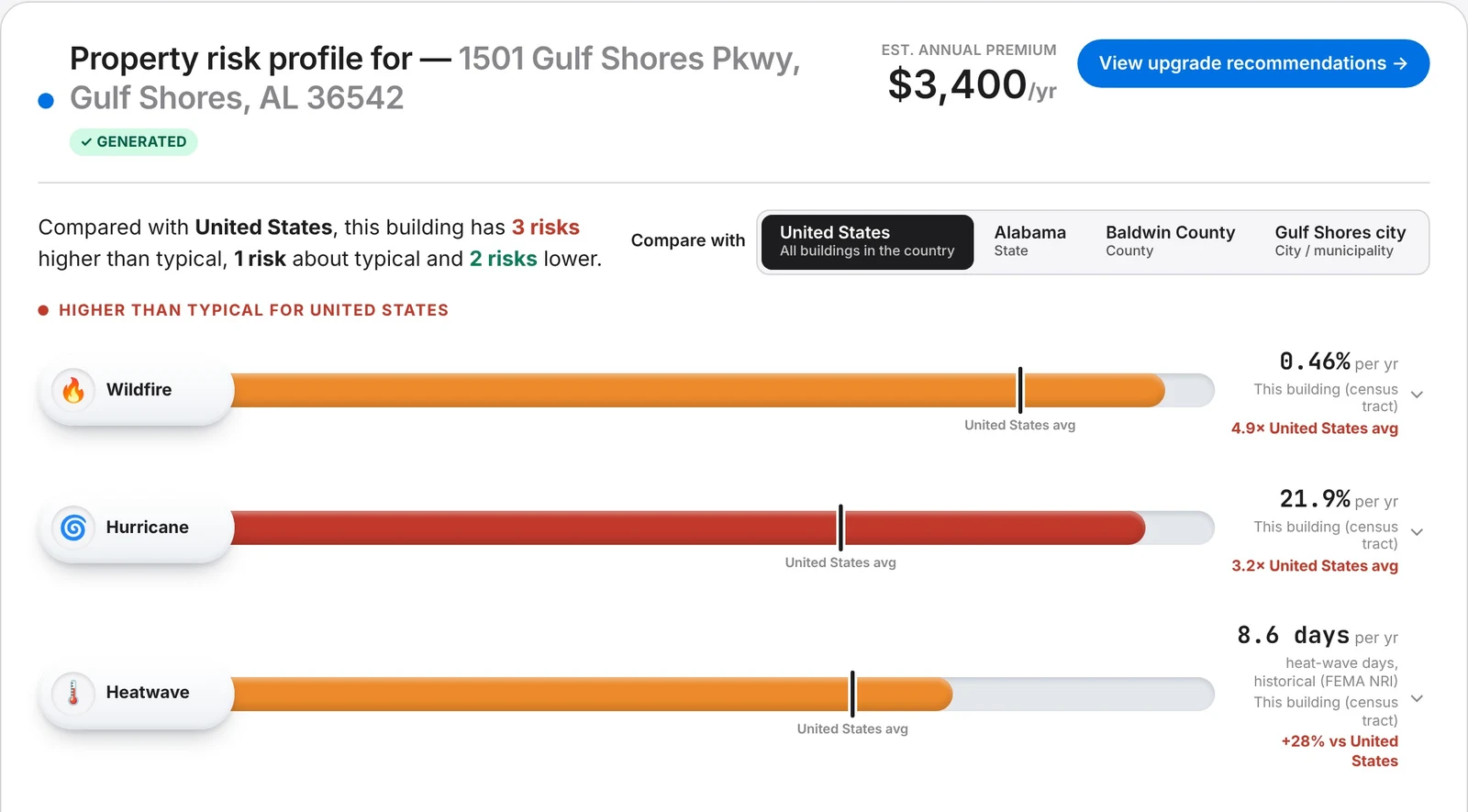
To make that concrete, we ran a typical detached home in Gulf Shores, Alabama, squarely in the high-wind territory respondents feel least ready for, through the AtlasAdapt demo, configured under a placeholder insurer brand. Using FEMA National Risk Index data, the risk profile puts annual hurricane frequency for the home’s census tract at about 3.2 times the US average.
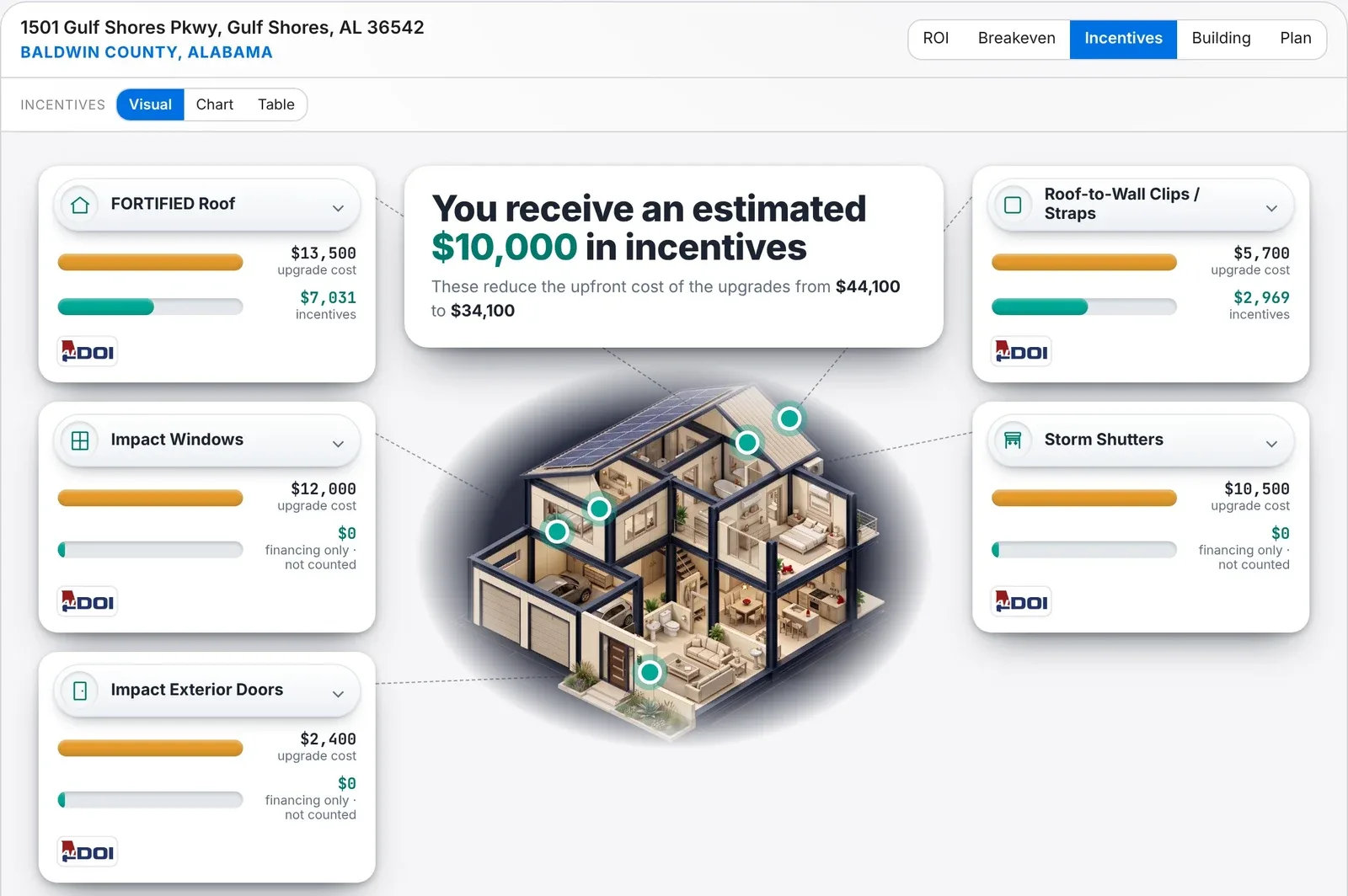
The tool then matches upgrades to the incentives available at that address. Alabama’s Strengthen Alabama Homes program, run by the Alabama Department of Insurance, pays 100% of eligible mitigation costs up to $10,000 per home. Applied to this home’s wind upgrades, that takes the estimated upfront cost from $44,100 to $34,100 before any insurance discount is counted.
The insurance side is real too, but it is an estimate rather than a calculation. Alabama law requires insurers to discount the wind portion of the premium for homes built or retrofitted to FORTIFIED standards. The Department of Insurance sets benchmark discounts by zone and FORTIFIED level, and an insurer that wants to go below them must justify it actuarially. Because what a given policyholder actually receives depends on their insurer’s filing, the tool shows that benchmark as a labeled estimate rather than as a precise saving.
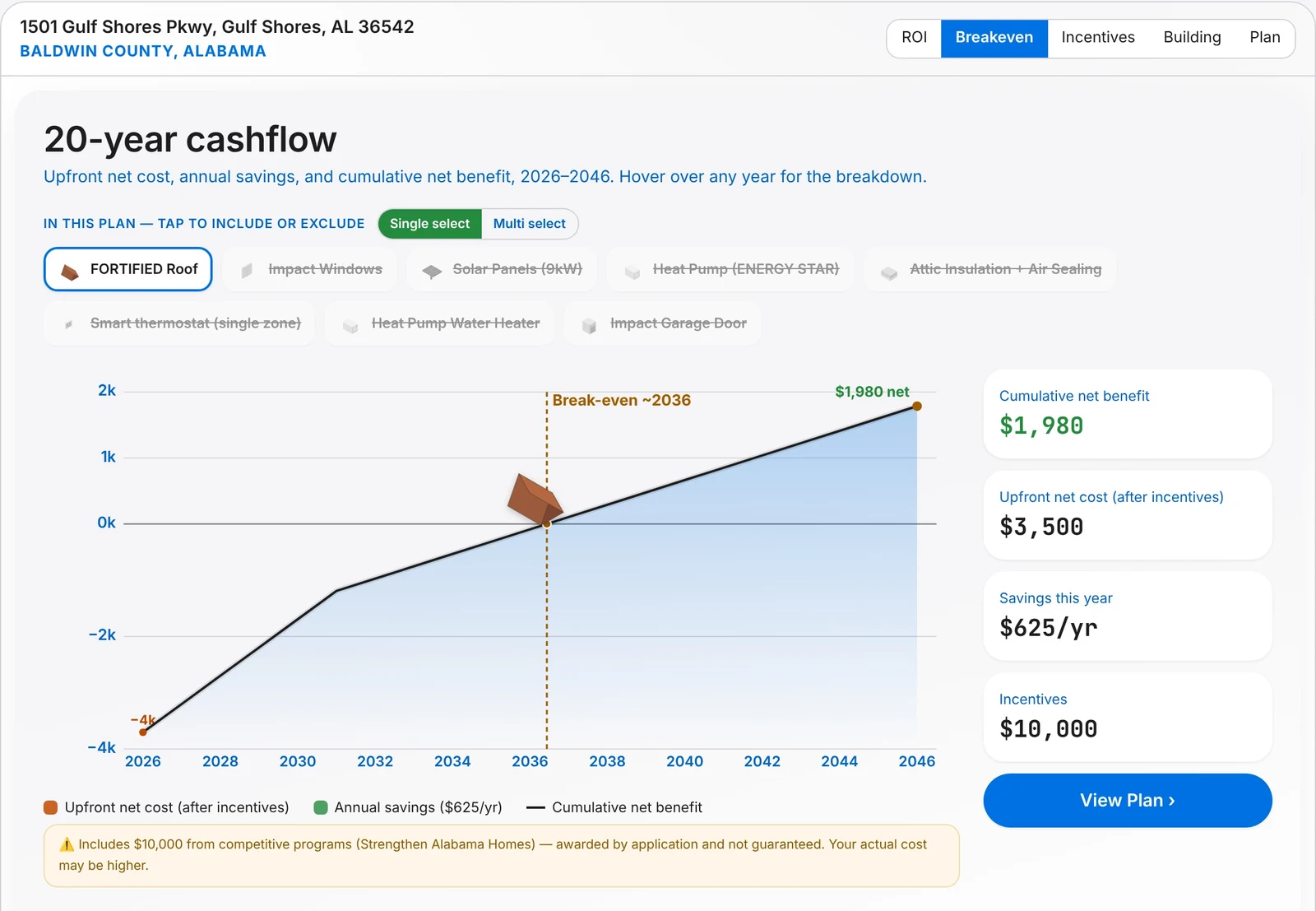
Finally, it lays out the cash flow, so the conversation ends with a payback date rather than another warning. Taken on its own, the FORTIFIED roof costs about $3,500 after the grant. Alabama’s benchmark discount is worth roughly $625 a year while the roof is new, falling after year five, and the roof breaks even in about ten years. That is a solid case, but not a two-year miracle, and that is exactly the kind of number a homeowner can plan around.
What this means if you insure, advise or lend
- Insurers and MGAs: the coverage confusion in this report is both a retention risk and a claims-experience risk. Showing policyholders which upgrades reduce their exposure, and what is available to fund them, is a loss-control conversation they can actually act on.
- Brokers and agents: 12% is a low baseline, and an opening. Renewal is the natural moment to turn an annual paperwork exchange into advice about the specific risks at that address.
- Lenders: 22% of homeowners who paid out of pocket are still carrying that debt, most of them for two years or more. Uninsured weather damage competes with every other obligation a borrower has, and grant-supported resilience upgrades are a financeable answer.
AtlasAdapt is white-label by design: insurers, brokers, MGAs and lenders put it in front of their own customers, under their own brand. If you would like to see it configured for your book, get in touch.
A note on the data
Hippo’s survey was fielded July 13–22, 2026 by Centiment among 1,047 US homeowners aged 18 and over. Data are census-balanced, with a margin of error of approximately ±3% at 95% confidence for the full sample, and wider for subgroups. Figures are self-reported. Hippo also reports that 11% of homeowners bought or renewed additional insurance protection this year, down from 15% in 2025; the 2025 survey used a different panel and methodology, so we would treat that comparison as directional. Gulf Shores figures come from the AtlasAdapt demo and are illustrative estimates for a typical home.
Source: Hippo, “Hippo’s 2026 Extreme Weather Report,” October 6, 2026