
Banks are beginning to price climate exposure into business lending. For lenders who want to use that moment to strengthen client relationships rather than simply withdraw credit, resilience intelligence provides a practical path forward.
When BBVA, one of Spain's largest banks, announced earlier this year that it is adjusting loan prices for corporate customers based on their exposure to global warming, it marked a significant step in the evolution of climate risk into mainstream lending practice. The bank is targeting sectors with the greatest physical exposure — agriculture, real estate, leisure, utilities and infrastructure — and has indicated that retail clients will follow.
BBVA is not alone. Across Europe and the US, banks are under increasing pressure from regulators, investors and rating agencies to account for physical climate risk in their lending portfolios. The insurance sector, which moves faster than banking on these issues, has already begun withdrawing coverage from the most exposed assets. As JPMorgan's global head of climate advisory put it recently: wherever assets are exposed, insurance prices "are going up" — and the stresses we see today will only worsen.

But here is the question that most lenders have not yet answered: once you have identified a borrower's climate exposure, what do you actually do with that information? Adjusting loan pricing is one response. But it is a passive one, and in competitive markets it may cost you client relationships without meaningfully reducing the underlying risk in your portfolio.
There is a more constructive answer — and it starts with giving borrowers a clear picture of what they can do.
From Risk Pricing to Risk Reduction
The most valuable thing a lender can do with climate exposure data is not to use it to reprice a loan. It is to use it as the starting point for a conversation about what the borrower can do to reduce that exposure — and therefore to improve their risk profile, potentially qualify for better financing terms, and protect the long-term value of the collateral underlying the loan.
That conversation is currently very difficult to have at scale, because the information required to support it is fragmented and hard to access. What resilience upgrades are available for a given property type in a given location? What do they cost? What grants, rebates and tax credits apply? How long do they take to pay for themselves through insurance savings, energy savings and avoided business disruption? And which government or utility-backed financing programs offer preferential rates for resilience-linked borrowing?
These are not questions with simple, stable answers. They require continuously maintained data across federal, state, municipal and utility sources, applied at the property level with eligibility logic and cost-estimation methodology that holds up to scrutiny.
What AtlasAdapt Provides
AtlasAdapt is built to make exactly that information available to lenders and their business customers — in a form that supports the lending conversation rather than requiring the borrower to do their own research.
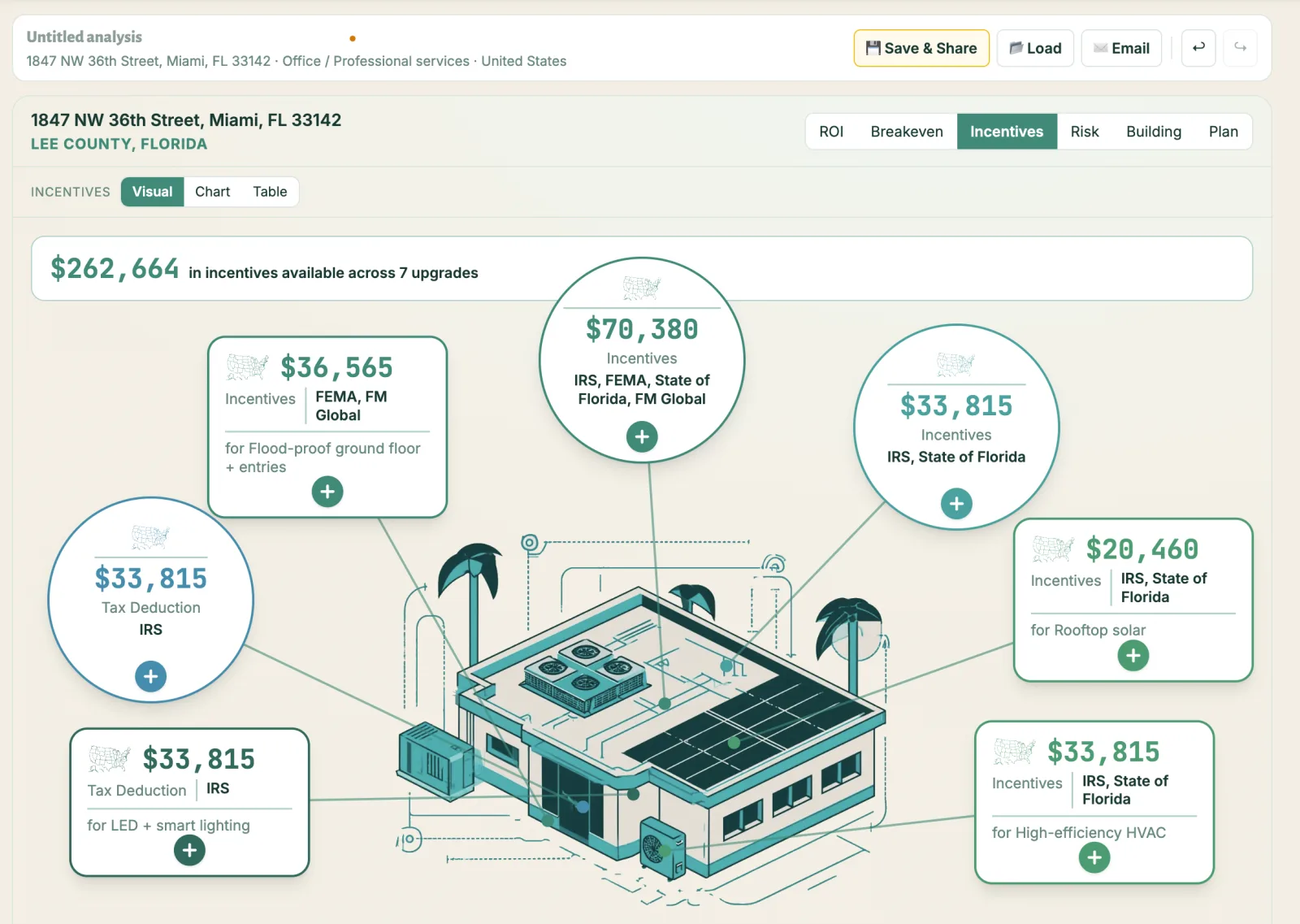
For lenders, that translates into white-label tools that can sit inside your existing client-facing infrastructure. A business customer enters their property address and a few details about their operations. They immediately see:
- Every incentive, grant and rebate program they qualify for, with estimated amounts
- The net cost of each resilience upgrade after incentives
- An annual savings estimate from reduced insurance and energy costs
- A cashflow chart showing time to break-even and cumulative benefit over five or ten years
The result is a materially different lending conversation. Instead of arriving at a credit review and telling a borrower that their climate exposure has increased their cost of capital, you arrive with a concrete plan: here are the upgrades that would reduce your exposure, here is what they cost after grants, here is how quickly they pay for themselves, and here is how we can help you finance them.
The Commercial Logic for Lenders
Several state and federal programs in the US already offer preferential interest rates for loans tied to resilience improvements — a dynamic that mirrors what BBVA describes in Spain, where government-backed incentives reduce the effective cost of financing climate-adaptive investment. A lender who can identify those programs for a borrower and combine them with their own financing offer is delivering genuine value, not just repricing risk.
Beyond individual transactions, there is a portfolio argument. A commercial lending book in which a meaningful proportion of borrowers have invested in resilience upgrades is a better-quality book than one where exposure is concentrated in un-adapted assets. The collateral holds its value better. Insurance remains available and affordable. The probability of disruption-driven default is lower. Regulatory scrutiny of climate-related risk concentrations is easier to address.
And there is a client retention dimension that should not be overlooked. Borrowers who receive actionable guidance from their lender — not just a higher rate, but a concrete plan for what to do about it — are more likely to remain clients through a difficult credit cycle than those who feel managed rather than advised.
The Broader Trend
BBVA's move is likely a preview of what becomes standard practice across commercial lending. The regulatory direction in both the US and Europe is toward greater disclosure and eventual integration of physical climate risk into capital requirements. Lenders who build the infrastructure to support borrower adaptation now will be better positioned when that integration becomes mandatory — and better placed to demonstrate to regulators that their portfolio management approach is proactive rather than reactive.
Allianz's board member made a point recently that applies equally to lenders: failing to help clients adapt does not make the risk disappear. It simply means the client eventually loses access to insurance or affordable credit, and the lender loses a relationship they might otherwise have retained.
AtlasAdapt exists to give lenders the tools to have a different kind of conversation — one that starts with the risk, moves immediately to what can be done about it, and ends with a client who understands why their lender is invested in their resilience.
AtlasAdapt delivers property resilience intelligence for lenders, insurers, brokers and property owners — white-label widgets, microsites and data APIs that surface incentives, model upgrade economics and support adaptation decisions. To see what our tools look like inside your brand and your client workflows, request a demo.
Sources
Climate Change Keeps Adding to List of Uninsurable Assets, Allianz Executive Says — Insurance Journal, July 1st 2026.